
Creating a vesting schedule
Vest ERC-20 tokens linearly to the owner over time on Robinhood Chain, with an optional cliff: set start, end and cliff in Titan Locker — irrevocable once created.
Updated 2 min read
On this page2 sections
Vesting releases tokens gradually instead of all at once on a single date. It's the standard way to hand out team, advisor, or investor allocations so tokens unlock over months rather than in one cliff-edge dump.
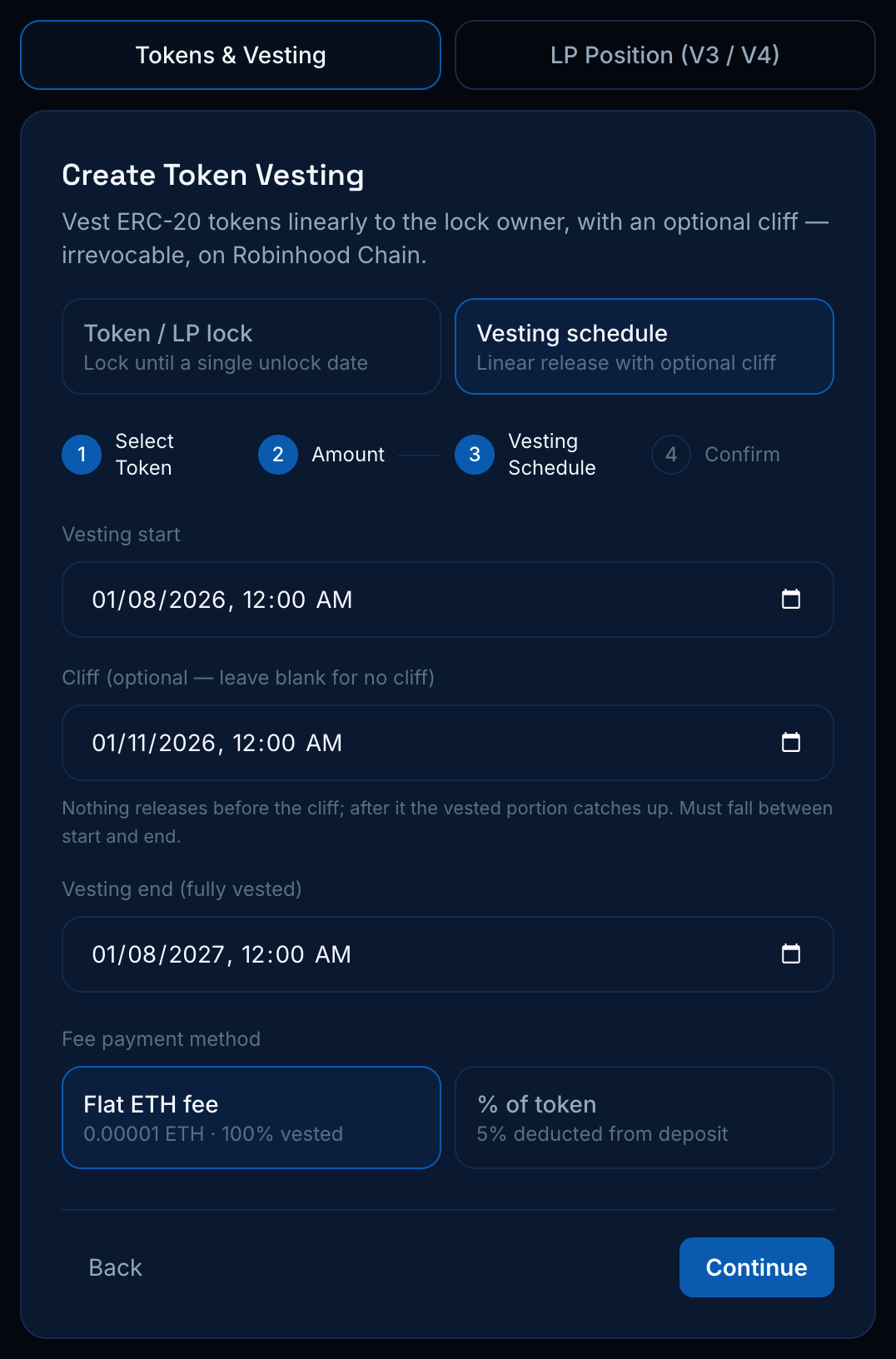
On the Create page, choose “Vesting” under “What are you locking?”. Select the token and amount exactly as for a token lock (with your balance and the 25%/50%/75%/MAX buttons), then define the schedule. The Lock summary shows the start, cliff and fully-vested dates and a timeline bar before you sign anything.
The schedule
- Starts — when linear vesting begins accruing. “Start now” fills in the current time.
- Fully vested after — when the full amount has vested. The 1M, 3M, 6M, 1Y and 2Y presets count from the start date.
- Cliff (optional) — nothing can be released before this moment; at the cliff, everything vested up to that point becomes releasable at once, then accrual continues linearly. Leave it blank (or press “Remove cliff”) for no cliff.
The schedule must satisfy start < end and start ≤ cliff ≤ end, with the end in the future — until it does, the button reads “Set the vesting schedule” instead of letting you submit. Then press “Approve & create vesting”: the same progress window as a token lock takes you through the approval and the vesting transaction, and links to the new lock's certificate.
How much is vested
At any moment the vested amount equals total × (now − start) ÷ (end − start), capped at the full amount from the end onward, and zero before the cliff. The owner claims the vested-but-unreleased amount at any time from the lock's page by calling release(); it can never pay out more than the schedule allows.